Author

Dr Rachel Horrocks-Birss
QAA Scotland
TAPPS Key Contact
Transforming Assessment Policy: Reflections on the third TAPPS Sharing Practice Event
Under the current STEP topic, ‘Supporting Diverse Learner Journeys’, the TAPPS project works to transform assessment and make learning more accessible. Given the increasing diversity of Scotland’s tertiary sector, traditional assessment practices no longer serve all students. TAPPS sharing practice events present examples of flexible, innovative, and inclusive assessments, tailored for supporting diverse student groups without increasing staff workload. On 7 May, 30 colleagues from across the tertiary sector gathered at the Kilmarnock campus of Ayrshire College to share practice and explore possibilities for broader change.
The day opened with introductions from Cameron Graham and Alison Greenwood-Bell, the TAPPS project leads. Alison provided an overview of STEP and the TQEF, reminding us of the broader enhancement context of assessment redesign. Cameron followed with insights from the TAPPS project, outlining work to influence assessment policy through a literature review and institutional policy analysis. Their introductions emphasised the need for change that goes beyond institutions as we adopt a whole-sector approach.
Keynote: Neuroinclusive Assessment in a Changing Tertiary Landscape
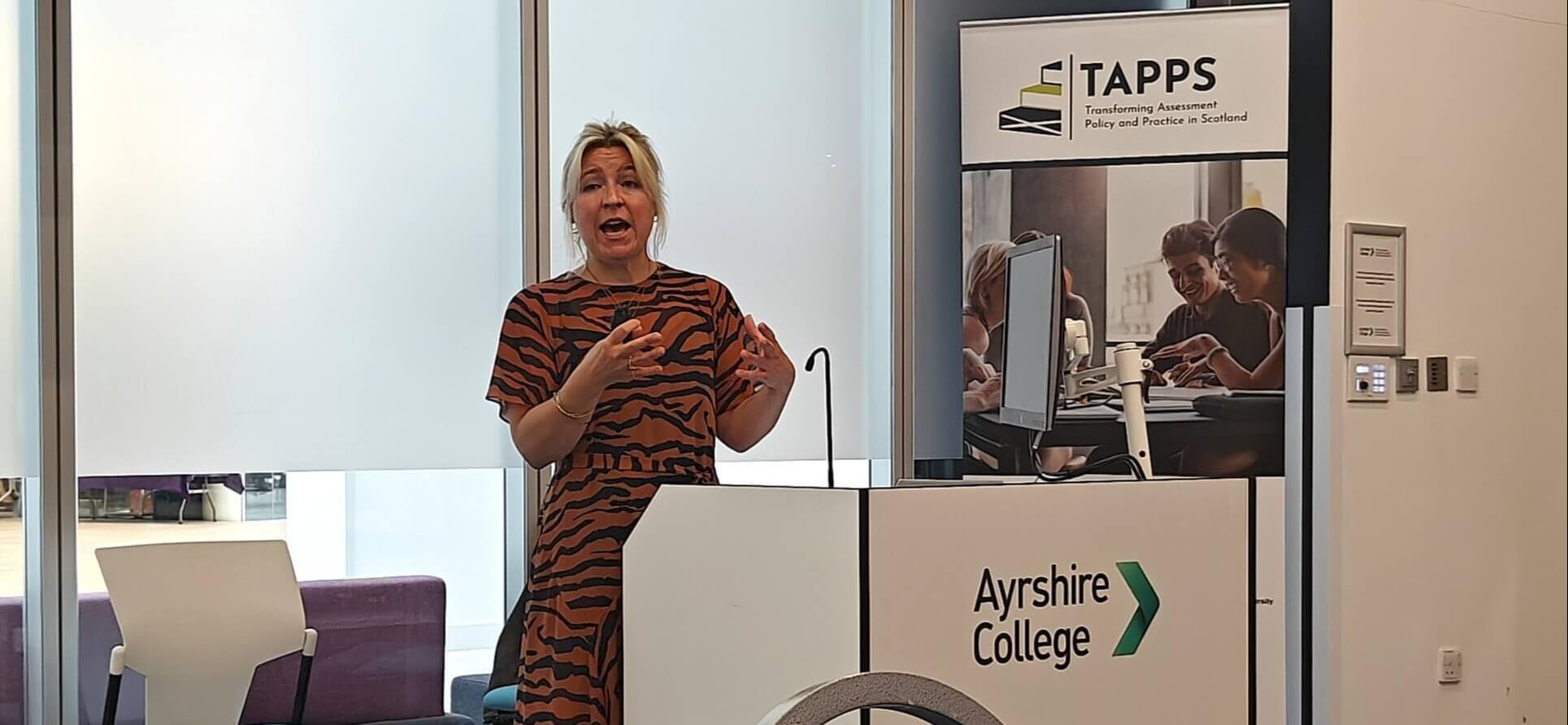
The keynote address, delivered by Molly Taylor from City of Glasgow College, offered a compelling exploration of neuroinclusive assessment. Molly began by highlighting the increasing diversity of Scotland’s tertiary student population and the challenges this poses for standardised assessment models. With the world of work shifting and many students entering higher education after disrupted schooling, traditional assessment formats are often misaligned with learners’ lived experiences.
Molly noted a striking rise in personal support plans at her institution (up nearly 50% in a single year) largely driven by neurodiversity rather than disability. She emphasised the distinction between neurodiverse (all brains are different) and neurodivergent (specific diagnoses), cautioning against narrow interpretations that risk excluding students who have not been diagnosed or do not wish to disclose.
Group discussions surfaced familiar challenges: how to support students when staff lack specialist training; how to design “reasonable” adjustments in a way that is fair and consistent; and how to rebuild trust with learners whose previous experiences of support were negative. Participants also reflected on the emotional dimensions of assessment, particularly the role of anxiety and stress. As Molly argued, traditional assessment often measures a student’s ability to cope with pressure rather than their actual learning.
Universal Design for Learning (UDL) principles provided a constructive way forward. Molly encouraged colleagues to focus on what is being assessed rather than how, reducing unnecessary barriers and allowing students to demonstrate knowledge in varied ways. Small changes, such as offering assessment briefs in multiple formats, providing checklists, or allowing additional processing time, can have significant impact. Crucially, she reminded the group that inclusive assessment does not equate to lower standards; rather, it strengthens academic integrity by ensuring assessments measure learning, not coping strategies.
In conclusion, Molly argued that assessment should not be a barrier to learning but a bridge to demonstrating it.
Workshops and Practice Sharing
The keynote was followed by a series of sharing practice presentations from colleagues across the tertiary sector, including four colleges and three universities.
Engineering Communication Skills at GCU
Ursula Canton and Andrew Cowell from Glasgow Caledonian University shared their work on improving communication skills among engineering students. Their literature review revealed a key tension: while academics often focus on whether a report demonstrates knowledge, industry prioritises whether it fulfils its functional purpose. To bridge this gap, they redesigned assessments to explicitly consider audience and context, introducing a two‑part structure and a rubric centred on what the reader should be able to do with the text. Early results have been promising, particularly among graduate apprentices, and the team is now exploring wider implementation.
Evidencing Learning Differently at Ayrshire College
Shona Howat, curriculum manager of Ayrshire College’s supported learning hub, described efforts to rethink assessment for learners whose needs were not being met by traditional approaches. She highlighted a persistent challenge: practices deemed acceptable in supported learning are often dismissed as insufficiently academic for mainstream programmes. By offering students multiple assessment options, such as creating wall displays, producing videos, or demonstrating practical skills directly, her team has been able to capture learning more authentically. Shona also noted the value of using tools like Copilot to generate new assessment ideas tailored to learner needs.
Dialogic Assessment in Criminology at Edinburgh Napier University
Francesca Soliman presented a redesign of a large fourth‑year criminology module that had suffered from low engagement and accessibility issues. Moving away from two lengthy essays, she introduced a short early test and a dialogic case‑study assessment in which students present an example of surveillance and discuss its relevance to module content. The format is not about presentation skills but about depth of understanding, with alternative formats available on request. The redesign has improved outcomes, reduced marking load, and generated more meaningful interactions with students.
Floorbooks and Observation at New College Lanarkshire
Nichola Nicol shared an innovative approach to developing reflective practice using 'floorbooks' - large scrapbooks commonly used in early years settings. Students document their learning visually and narratively, creating artefacts they can take to job or university interviews. While challenges remain, such as cost and photo‑permission processes, the approach has strengthened students’ ability to articulate their learning journeys.
Mascots and Conceptual Learning at City of Glasgow College
Mark Bonatti offered a creative way to engage students, describing how he uses a classroom mascot - 2T the tutorial robot - to support animation students who struggle with technical terminology. By working through animation processes using the robot, students can focus on conceptual understanding before grappling with specialist language. The approach has increased engagement, improved pass rates, and fostered a stronger sense of belonging. Mark also shared suggestions for adapting mascot‑based learning to other disciplines through consistent imagery, narrative, and character‑based examples.
Diverse Assessment Methods in Social Sciences at Ayrshire College
Janette Steel discussed the importance of offering varied assessment types within social sciences, where written work is often prioritised. Her team has experimented with posters, Sway presentations, timelines created in Canva, and even student‑produced podcasts. Low‑stakes assessments and instant‑feedback MCQs have helped reduce anxiety and support continuous learning, while staff often found marking verbal assessments to be a more enjoyable experience, as they marked with their ears rather than their eyes. Janette emphasised that diverse assessment can reduce stigma for neurodivergent students as it benefits the whole student body by focussing on outcomes rather than assessment competence.
Creative Leadership Assessment at the University of Stirling
Kay Sidebottom closed the day with a thought‑provoking presentation on disrupting dominant leadership paradigms. Teaching a diverse cohort on a Masters leadership module, she sought to move beyond Western, male‑centred models by redesigning both content and assessment. Students now produce leadership portfolios, including reflective journals, digital artefacts, and critical commentary, encouraging diffractive thinking, collaboration, and storytelling. The results have been academically rigorous and provide students with practical evidence to share with potential employers.
Cross‑Cutting Themes
Discussions across the day demonstrated a strong appetite for greater assessment variety across the sector. Participants agreed that that inclusive assessment benefits all learners, not only neurodivergent students, and expressed a desire for clearer policies legitimising diverse assessment types. Although non-traditional assessments can often be seen as less rigorous, the sharing practice event highlighted a commitment to maintaining academic standards while modernising assessment practice. The case studies and discussions demonstrate how flexible and inclusive assessments benefit both staff and students, and there is a clear need for institutions and awarding bodies to redevelop policies to encourage innovative assessment.