Staff Development State of Play Report
Publication date: 28 Aug 2026
The STEP Staff Development project explores how educators (those who teach and/or support learning) across the tertiary education sector are supported in developing their educational practice to meet the increasingly diverse needs of students. Rooted in the STEP topic of Supporting Diverse Learner Journeys, the project recognises that educators are also themselves learners, with their own diverse learner journeys, backgrounds, and development needs.
Our first project output, the Staff Development State of Play Report, explores how educators (those who teach and / or support learning) are equipped with the knowledge, skills, and competencies required to meet the needs of increasingly diverse learner journeys.
We are
inviting stakeholders to respond to the State of Play Report through a Consultation Questionnaire.
For further information or if you have any queries, please contact the lead researcher: c.matysova@gsa.ac.uk.
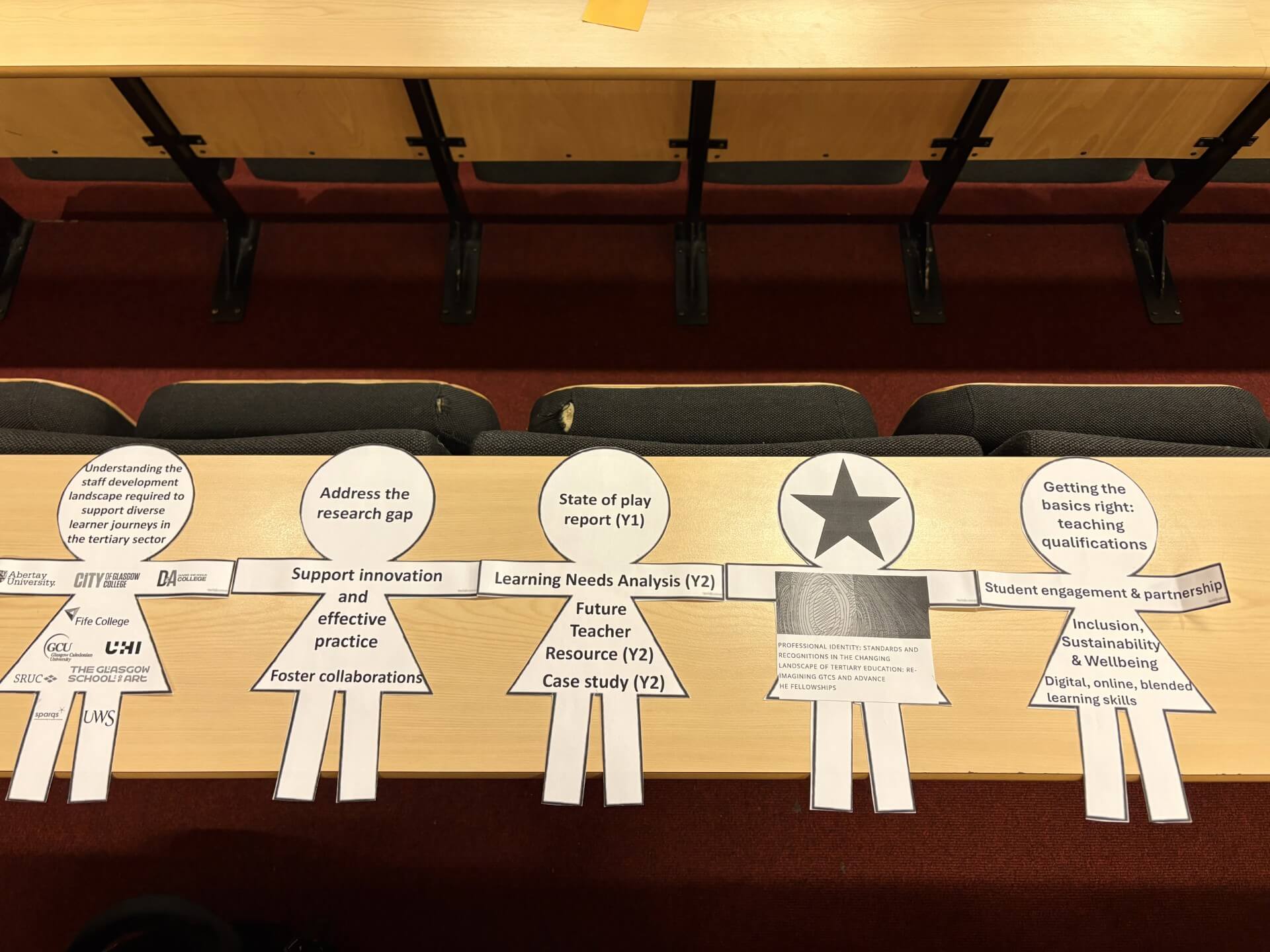
The project sets out to:
The STEP Staff Development project is led collaboratively by the Glasgow School of Art, City of Glasgow College, and the University West of Scotland through a shared leadership structure involving Leadership, Steering Group (comprising Collaborative and Student Partners), Delivery Team, and Consultative Partners.
Partners include Abertay University, Dundee and Angus College, Fife College, Glasgow Caledonian University, the Royal Conservatoire of Scotland, Scotland’s Rural College, UHI Orkney, UHI Shetland, and sparqs.
The project combines a comprehensive literature review with stakeholder engagement activities to generate a detailed understanding of educator development practices that support diverse learner journeys across Scotland’s tertiary education sector.
The stakeholder engagement activities include a consultation questionnaire and call for case studies that showcase effective and innovative educator development practices that enhance learning, teaching and assessment. In addition, the project will co-create with students a resource exploring students’ perspectives on the ‘future educator’ within the tertiary context.
Activity Name | Activity Details | Timing |
| State of Play Report | Desk-based analysis of existing literature, policy and research on approaches to educator development across the tertiary sector | 2025-2026 |
| State of Play Consultation Questionnaire | Distributed with the State of Play Report to gather perspectives from educators, students and institutions | 2026-2027 |
| High Impact Case Studies | Describing educator development, how it was implemented and demonstrating impact on educators, students, programmes, institutions and the sector | 2026-2027 |
| Student Co-Created Future Educator Resource | Explores students’ perspectives on the future educator in the tertiary context, co-created with students | 2026-2027 |
| Final Findings Report | Synthesises evidence from stakeholder engagement to inform sector-wide recommendations | June 2027 |
Publication date: 28 Aug 2026
As the first project output, the State of Play Report provides a desk-based analysis of existing literature, policy and research on the approaches to educator development across the tertiary sector.
It explores how educators (those who teach and / or support learning) are equipped with the knowledge, skills, and competencies required to meet the needs of increasingly diverse learner journeys. The report situates these considerations within the national policy shift toward a more coherent tertiary education system and the ongoing professionalisation of teaching.
Drawing on demographic data, stakeholder perspectives, and sector literature, the report examines the concept of diverse learner journeys and the implications for educators’ own learning and development. It analyses the critical influences shaping educator development, including national policy, institutional priorities, and evolving professional expectations, and it considers how educator development is operationalised across further, higher and tertiary education institutions.
The State of Play Report identifies shared challenges and opportunities for collaboration across the tertiary sector. Shared challenges included measuring the long-term impact of educator development, both at institutional and individual levels. Meanwhile, differences in FE and HE sector structures - particularly around professional educator development - shape how learning and teaching are supported. Emerging development needs, and how these needs are met, are explored through practice examples at individual, programme, departmental, and institutional levels. These examples illustrate how educator development can support innovation, inclusivity, and responsiveness to diverse learner needs.
The report highlights implications for tertiary educator development as well as further areas for enquiry as move into the second year of the project. These include:
Publication date: 07 Sep 2026
The State of Play Report will be used to support strategic conversations about educator development with stakeholders including those in leadership, those who support and develop educators, and educators themselves recognising them as diverse learners.
Through stakeholder engagement, we aim to determine if the report accurately reflects educator development in tertiary education, identify any major gaps, and gather opinions on the future direction of educator development.
We are inviting stakeholders to respond to the State of Play Report through a Consultation Questionnaire. You will find a Participant Information Sheet above
How to respond:
As part of the Scottish Tertiary Enhancement Programme (STEP) Staff Development project, we will be inviting submissions of high impact case studies showcasing effective and innovative educator development practices that enhance learning, teaching and assessment to meet the increasingly diverse needs of students.
Case studies may focus on development initiatives that have influenced:
Each case study should provide a narrative account describing:
Contributors will be able to choose from a range of formats to present their case study, including, written narratives as well as photographs and video media.
Further information to follow in autumn 2026.
As part of the project, we will also co-create with students a resource exploring students’ perspectives on the 'future educator' within the tertiary context, ensuring learner voices inform the evolving narrative of professional learning. We will recruit two Student Consultants to co-create and deliver with the Research Fellow a series of student focus groups to capture students’ perspectives and ambitions as to:
Further information to follow in autumn 2026.