
STEM Students Report V2
Publication date: 05 Oct 2026
This project was led by Robert Gordon University, with the University of Aberdeen and SRUC as collaborative partners. It addressed the STEP priority area of delivering tailored, targeted and personalised support by examining a persistent challenge in tertiary education: students may be surrounded by support services but still be uncertain about where to start, which service is appropriate, how services connect, and what happens after referral.
For STEM learners, the support journey can be especially complex because a presenting issue may be technical, academic and personal at the same time. A student struggling with a laboratory task may subsequently miss an assessment, lose confidence and disengage. A programming difficulty may be compounded by workload, employment or wellbeing pressures. The project therefore treated the student journey, not the institutional organizational chart, as the primary design frame.
An initial review of institutional practice, covering 15 universities and 14 colleges, found that the principal challenge is not simply the availability of support, but the visibility, navigation, coordination and continuity of that support. Interviews with students showed that support needs overlap: academic learning difficulties frequently co-occurred with workload, wellbeing, financial or technical pressures.
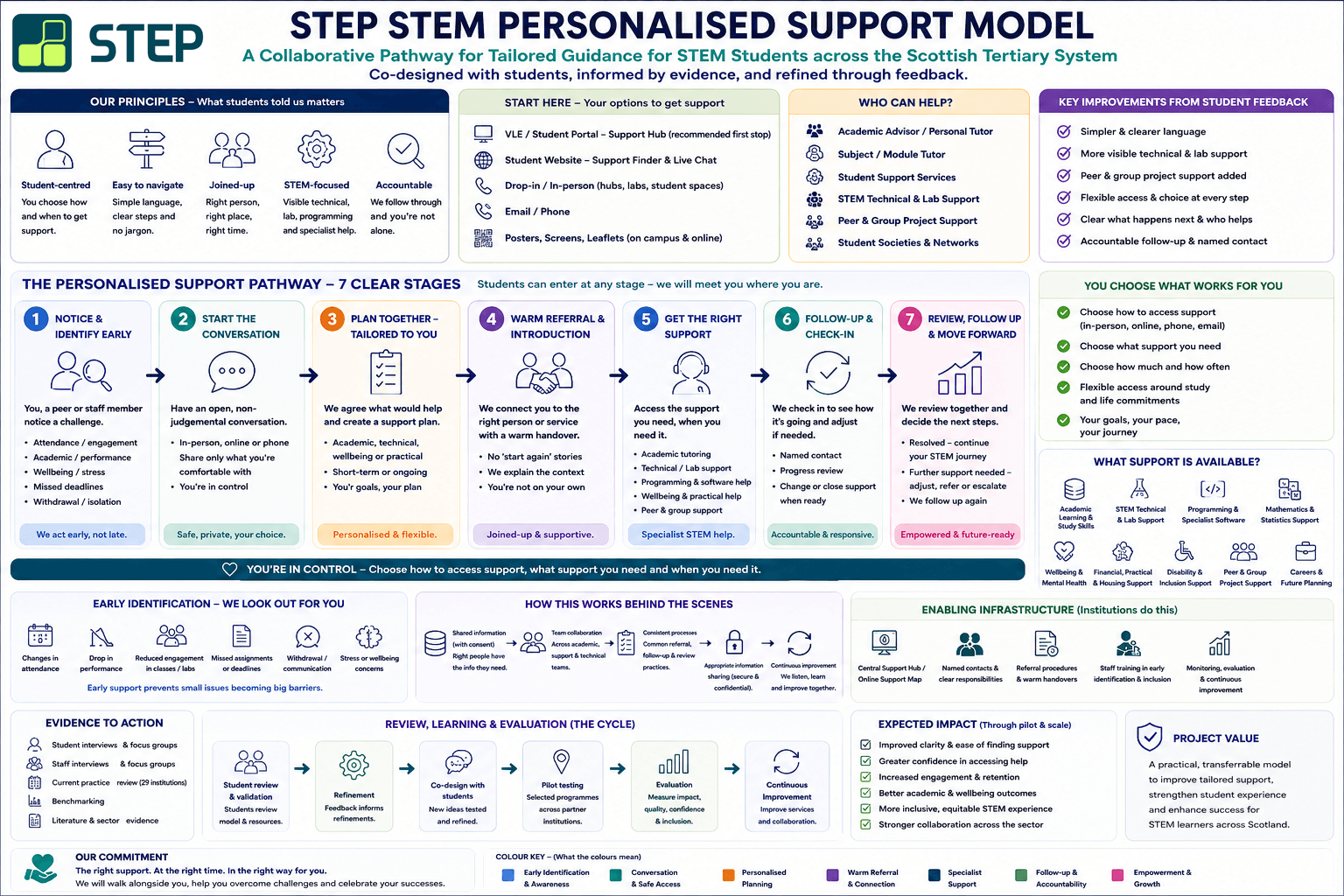
The research led to the development of the STEM Personalised Support Model, which was co-designed with students and other stakeholders and has seven stages: notice and identify early; start the conversation; plan together; warm referral and introduction; get the right support; follow-up and check-in; and review, close or escalate.
On this page you will find information about the STEM Personalised Support Model, as well as the research that led to its development and a number of supporting resources.
The project aimed to design, test and refine a coordinated model for delivering tailored, targeted and personalised support for STEM students that can be adopted across the Scottish tertiary sector.
Project objectives were as follows:
The table below sets out the seven-stage STEM Personalised Support Model.
The model is designed to be transferable: institutions do not need identical service names or structures, but can map local services onto the same expectations for entry, clarification, referral, support delivery, follow-up and review.
| Stage | Operational meaning |
| 1. Notice and identify early | Self-referral, peer observation or supportive staff check-in; early indicators trigger conversation, not diagnosis. |
| 2. Start the conversation | A safe, non-judgmental first contact through a hub, portal/VLE, tutor, programme team, academic/technical staff, professional services or peer route. |
| 3. Plan together | Clarify the situation, urgency, mix of needs and preferred access route; agree immediate and longer-term actions. |
| 4. Warm referral and introduction | Connect the student directly to the right person/service, explain what happens next and minimise repeated retelling. |
| 5. Get the right support | Provide academic, technical/lab, maths/programming, digital/software, wellbeing, inclusion, financial, careers, placement, peer or other specialist support. |
| 6. Follow-up and check-in | Confirm whether the student reached the service, received appropriate support and needs further action. |
| 7. Review, close or escalate | Close when resolved; if unresolved or complex, coordinate additional support, redirect or escalate and follow up again. |
The model is intended to be:
Publication date: 05 Oct 2026
Publication date: 05 Oct 2026
Publication date: 05 Oct 2026
Publication date: 05 Oct 2026
Publication date: 05 Oct 2026