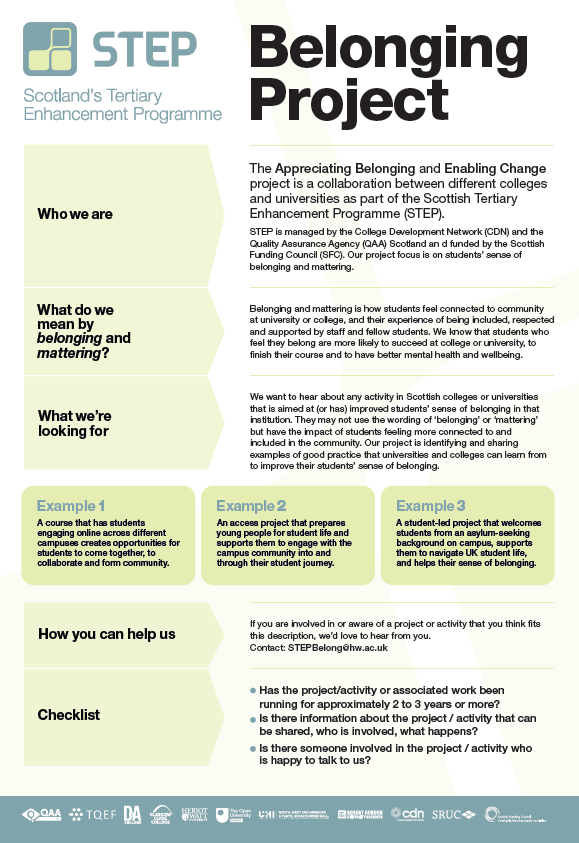
STEP Belonging Project - A3 poster
Publication date: 09 Jun 2026
Belonging and mattering concern students’ relationships, their sense of value and agency, and their experience of studying at college or university. Institutions increasingly recognise their importance, but need evidence about what works in different settings.
This project takes an appreciative approach. It learns from initiatives already established across Scotland’s tertiary sector, exploring what they do, how they have endured, and what their evaluation tells us. Students and staff work together to share that learning with others.
At a glance: More than 20 examples identified; six initiatives selected for detailed study; seven collaborating institutions.
Six belonging initiatives were selected for more detailed study because they had been sustained for at least two years, embedded in practice, evaluated, and could be shared with the sector. Interviews and supporting material help the team examine implementation, context and evidence of impact. Analysis across all six is continuing.
Dundee and Angus College: Creating belonging through community-centred and relational practice
A range of connected initiatives such as Touch Points, informal student voice activities, and being the first college in Scotland to be recognised as a College of Sanctuary, aim to ensure students feel welcomed, valued and supported. Evidence being examined includes attendance, retention, learner survey data, student voice, and feedback from learners, families and community partners.
Glasgow Clyde College: Embedding nurture across a college
A whole-college nurture strategy responds to students’ changing support needs through staff development, self-evaluation, peer support and improvements informed by data. Evidence being examined includes nurture self-evaluation, student withdrawal and satisfaction, staff engagement and qualitative feedback.
LEAPS: Supporting transition to higher education through sustained pre-entry engagement
The LEAPS Transitions Course (hosted by the University of Edinburgh) provides underrepresented school pupils with university-level learning, academic skills development and personalised tutor support before entry to higher education. Evidence being examined includes student confidence, sense of mattering, progression to university, retention and longitudinal learner feedback.
Open University in Scotland: Welcoming students before study begins
Accessible online Welcome Events introduce distance learners to staff, peers, university systems and support services. Early contact is intended to strengthen confidence and connection before teaching starts. Evidence being examined includes participation, confidence polls, student feedback and continuation data.
Queen Margaret University: Building belonging through peer-assisted learning
Peer-Assisted Learning (PALS) uses trained student leaders to facilitate collaborative learning and peer connection within challenging modules. The approach aims to strengthen academic confidence, community and belonging for all students. Evidence being examined includes attendance, attainment, continuation, student surveys and qualitative feedback.
University of Abertay: Embedding student success and belonging in the curriculum
The MySuccess modules provide all first-year students with structured support for academic, personal and social transition, alongside targeted early intervention and peer support. Evidence being examined includes module engagement, retention, progression, student feedback and outcomes for different student groups.
The search for ‘deep dive’ cases uncovered a wide range of meaningful work, initiatives and programmes that varied in context and focus. The team heard from students and staff across the tertiary sector that they wanted to hear about this wider range of practices, to learn from these. The team is developing short ‘Insight Examples’ to showcase the range of approaches taken across colleges and universities.
Patterns emerging across the examples
Themes are emergent from the Insights Examples including: Care for individual students; a clear reason for change; systems responsive to student feedback; and curriculum design that supports success. These are early observations from the project presentations, rather than final findings from the six-study analysis.
The September 2026 presentations of the project work highlighted two existing resources that may help staff and students discuss belonging and evaluate changes in practice.
Student Learning Experience Model (sparqs)
sparqs’ reflective questions can prompt conversations between students and staff about community, inclusion and the learning environment.
Universal Evaluation Framework
Evaluation for All offers an open access framework for planning an evaluation and gathering evidence of what has changed.
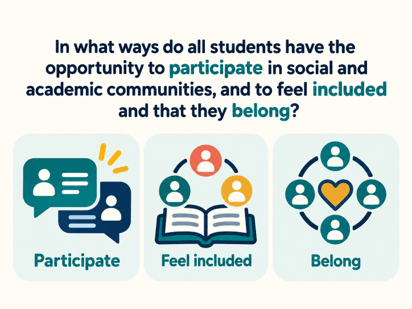

Resources on OpenLearn
Resources for staff, students and institutions will be made available through the Open University’s OpenLearn platform. They will support readers to develop strategies for belonging and mattering that fit their own context. The project resource page is in development.
Events and opportunities to connect
Information about forthcoming events and opportunities to discuss the project’s learning will be shared through the project’s LinkedIn page, OpenLearn and the STEP Network.
Lead: Heriot-Watt University
Co-lead: Dundee and Angus College
Collaborative partners: Glasgow Clyde College; Open University in Scotland; Robert Gordon University; Scotland’s Rural College; and UHI North, West and Hebrides
The project also works with consultative partners from across the sector.
Read more about the project on the Heriot-Watt University, Learning and Teaching Academy project page, and follow updates on the STEP Belonging Project LinkedIn page. To share an example of work supporting belonging and mattering, or to ask about the project, email STEPBelong@hw.ac.uk
Project page: https://lta.hw.ac.uk/step-appreciating-belonging-and-enabling-change/
Email: STEPBelong@hw.ac.uk
The Belonging Project team want to hear about any activity in Scottish colleges or universities that is aimed at improving, or has improved, students’ sense of belonging in that institution. They may not use the wording of ‘belonging’ or ‘mattering’ but have the impact of students feeling more connected to and included in the community. The project is identifying and sharing examples of good practice that universities and colleges can learn from to improve their students’ sense of belonging.
For more information, including possible examples and contact details, please see the attached flyer.
Publication date: 09 Jun 2026